

How to talk so people listen. (And listen so people talk)
The people who get listened to at work are not the loudest, the smartest, or the most senior. They are the ones who learned two skills: how to talk so people listen, and how to listen so people talk.
A one-day workshop that combines the art of acting with the science of psychology. Then Heard, conversational AI built to win the yes, keeps counting after the room empties.










Most business problems are people problems. Most people problems are communication problems.
"Communication" keeps coming up.
It is on every review and every after-action report, and it is always too vague to fix.
The training covers the process, not the people.
Your people learn the systems, the checklist and the regulations. The conversation is left to chance.
New people every month.
New managers, new recruiters, new hires. Each one has to earn trust with someone they just met, and do-overs are expensive.
A conversation someone keeps putting off.
It has been months. When they finally have it, it is rarely as hard as they feared.
One day. Two skills.
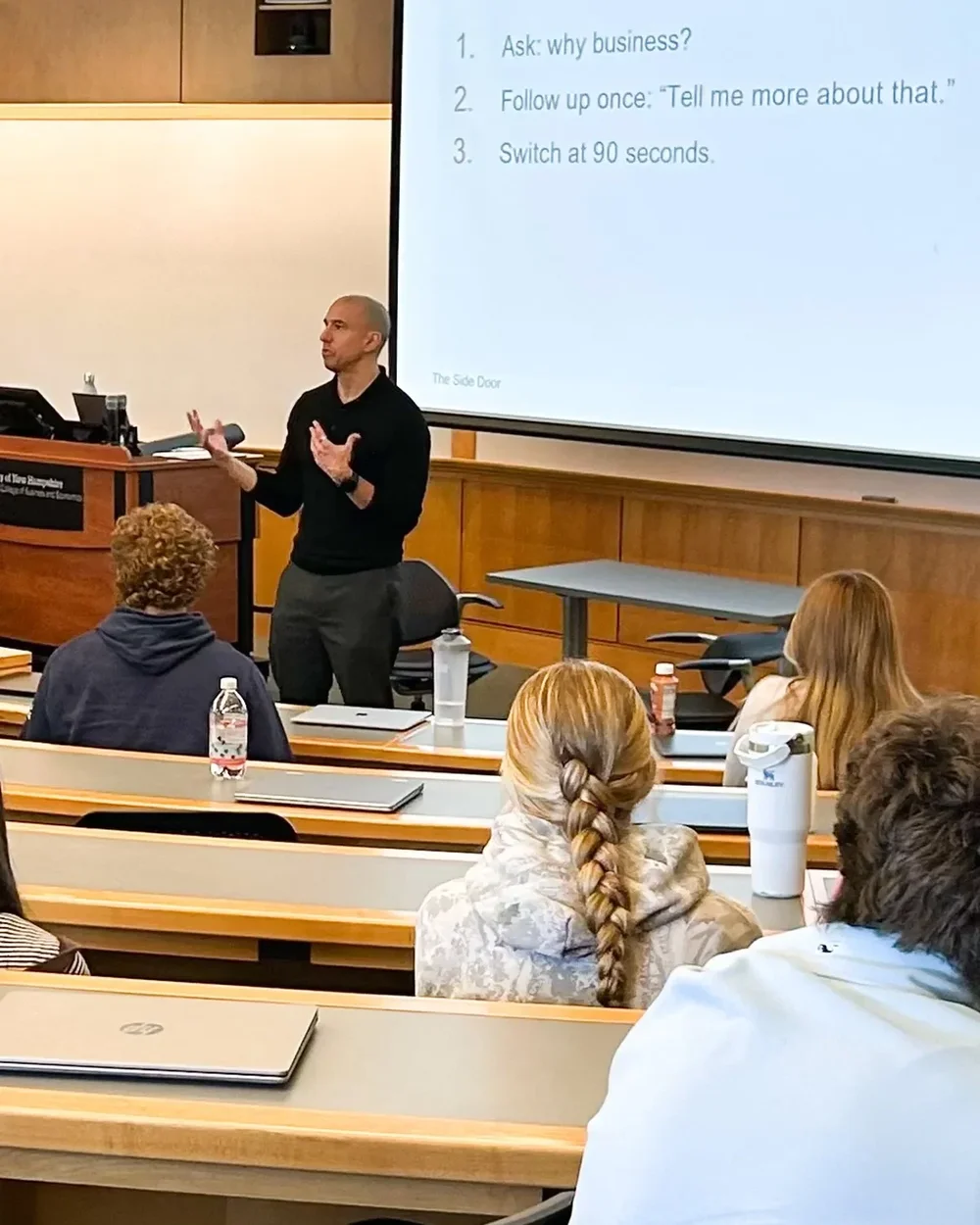
This one-day workshop combines the art of acting with the science of psychology. You will learn the same techniques the world's greatest stage and screen actors use to captivate an audience, the psychology of why they work, and how to use them in your next meeting, your next one-on-one, and your next hard conversation at home. Then you will practice them, with a partner, until they are yours.
Not a lecture.
People are up and working in pairs, on conversations from their own jobs.
Built around your world.
Every exercise is fitted to the people in the room, in the words they use at work.
Tools for tomorrow morning.
Things to say and do in the next meeting, the next one-on-one and the next first conversation.
How to talk so people listen
- How to get to the point in the first thirty seconds so people follow you and remember what you said
- The secret for holding a room: where to put your attention so people cannot look away
- How to say the hard thing without triggering defensiveness
- How to use your voice and your body so what you say lands the way you meant it
- How to stop rehearsing in your head and respond to what is actually happening in front of you
How to listen so people talk
- The six listening moves that make a person feel heard in the first two minutes and keep them talking when it gets uncomfortable
- Why closed questions shut people down, and what to ask instead
- The reflection habit that makes people open up, and how many times to use it before you ask anything
- What to do at the exact moment the other person gets upset, quiet, or defensive
- How to stop fixing, soothing, and solving, and listen in a way that gets you the truth
Heard. AI built to win the yes.
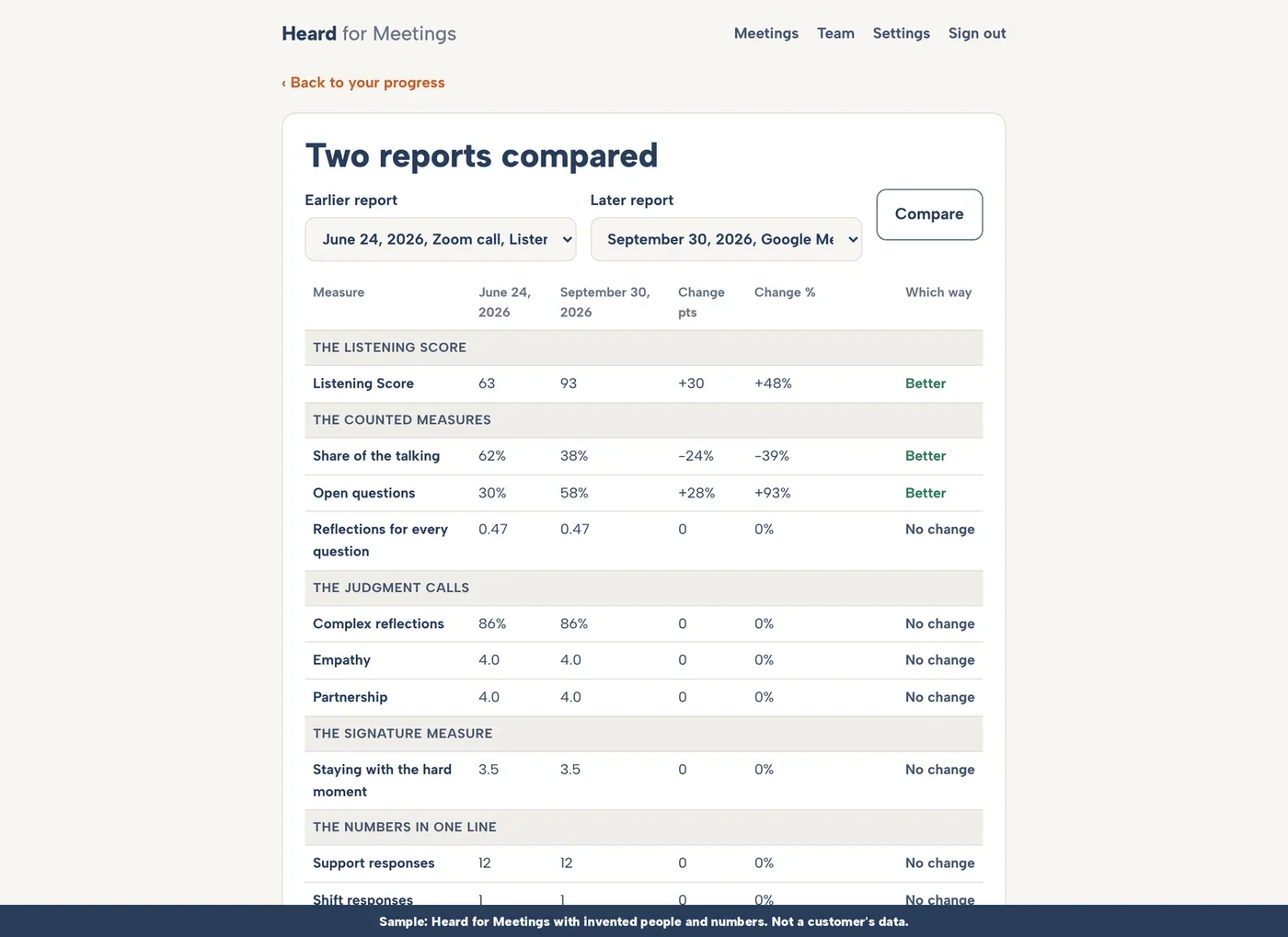
Most of what you want lives on the other side of someone else's yes, and people say yes more often when they feel heard. The workshop teaches it. Heard is the conversational AI that measures it. It analyzes a real conversation and gives you feedback on how you communicated, not only how you listened: your share of the talking, the questions you asked, the empathy you showed, and whether you stayed with the other person in a hard moment.
Heard for Meetings™
You can't be on every call. Heard joins your team's two-person Zoom, Microsoft Teams and Google Meet calls. After each call, the person who sent it gets a report on how they communicated: listening, empathy and the hard moments. Managers see the whole team on one page.
Start with one seatHeard: Who Really Listened™
Free to download for iPhone, for conversations in person.
Get it on the App StoreHonest by design. Every measure is labeled by how reliable it is. In the workshop, measuring a conversation is each person's own choice.
See how Heard works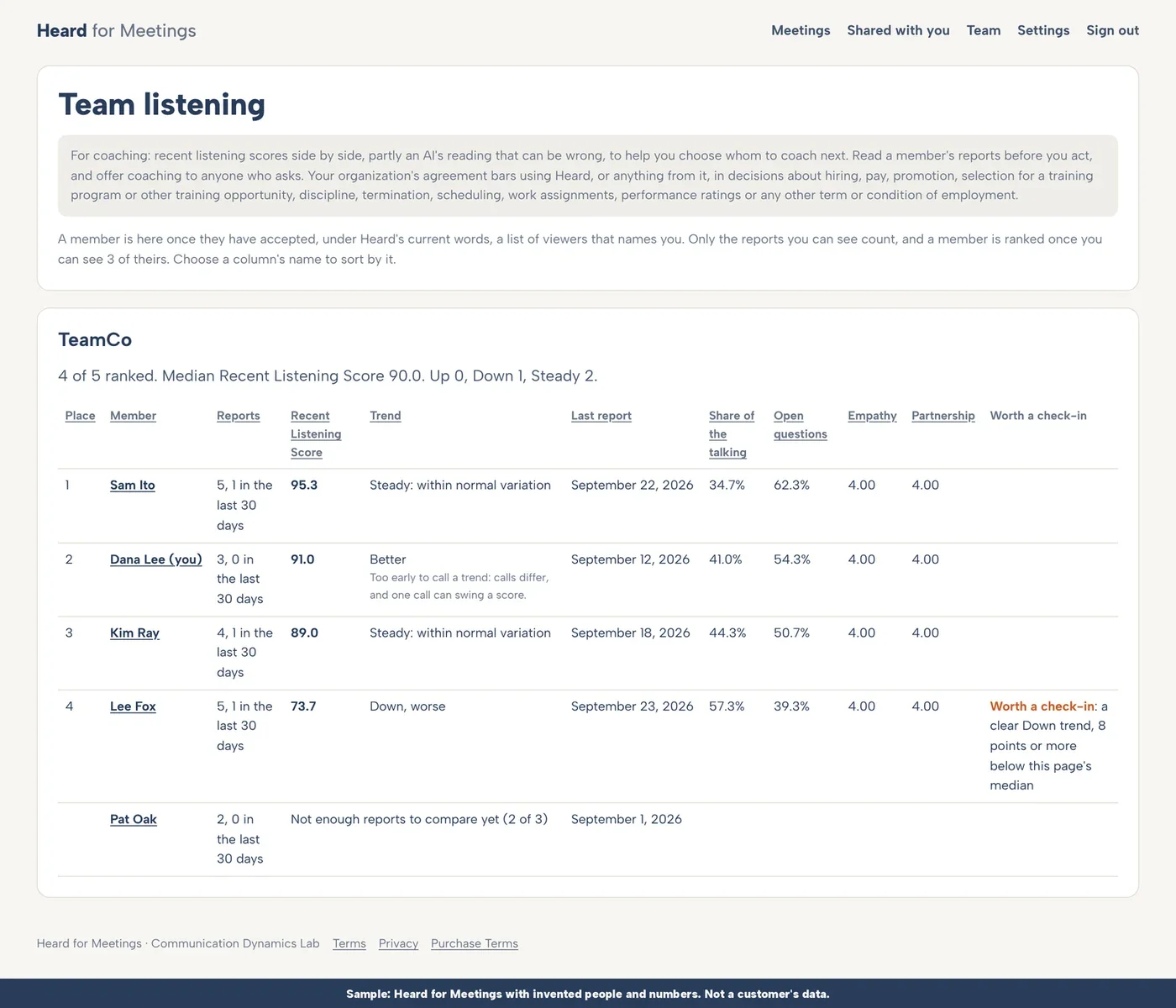
Ask people how well they listen. Then score the recording.
of the time, nurses rated their own effort to understand the patient as high.
25 of 30 sessions.
of the time, coders listening to the recordings scored their empathy as high.
10 of 32 sessions.
The same 12 nurses, in the same recorded patient sessions. None of the 12 reached the beginner mark on every measure. Östlund and others, 2015. Heard scores the conversation itself, so nobody has to take their own word for it.
Employees rated how 144 managers listened. Of the 36 managers they ranked in the bottom quarter, 94% rated themselves good or very good listeners.
Brownell, 1990In visits where clinicians asked what the patient wanted to discuss, they cut in two times in three, after a median of 11 seconds.
Singh Ospina and others, 2019Across training studies, skills eroded over the six months after a workshop when no feedback or coaching followed. With feedback or coaching, they held.
Schwalbe, Oh and Zweben, 2014For people whose work runs on someone else's yes.
Every exercise is geared to the people in the room and the conversations they actually have.
People leaders
New and seasoned managers who were trained on the process and now have to lead people.
For people leadersRecruiters and sales teams
Anyone who sits down with a stranger and has under an hour to build rapport, earn trust and find out what they care about.
For recruiters and sales teamsOperations and care teams
People across shifts, sites and disciplines who have to be understood the first time.
For operations and care teamsTraining partners
University programs, workforce offices and associations that want a session people sign up for and talk about afterward.
For training partners"Forget everything you know about forced team-building, corporate-bonding, hours-long seminars...this session will actually make you a better communicator and strengthen your relationship to your coworkers in a deep, meaningful way."

Michael Cinquino
Michael holds an MFA in acting from Rutgers and has a Master's in Clinical Mental Health in progress at Northwestern. He spent a decade behind closed doors with Fortune 70 executives and is a former professor at the University of New Hampshire's Peter T. Paul College of Business and Economics, where he taught communication.
Michael teaches at the intersection of performing arts and the science of psychology.
Read Michael's story
Veteran-owned. An SBA Veteran-Owned Certified business, and a clean fit for supplier-diversity and procurement requirements.
Plain prices. No surprises on the call.
The one-day workshop
Minimum 8 people. No cap on the room. Travel billed at cost. Every participant receives a certificate of completion and a free month of Heard for Meetings™.
Heard for Meetings™
One report a week. Or $59 a seat a month, with four reports a month. For two-person Zoom, Microsoft Teams and Google Meet calls.
Heard: Who Really Listened™
For iPhone. Scores a conversation in the room.
Tell us your dates and headcount. We'll follow up with a quote. A six-session virtual lab is also available.
Bring the workshop to your team.
Tell us your dates and headcount. We'll follow up with a quote.