How To Talk So People Listen
(And Listen So People Talk)
The people who get listened to at work are not the loudest, the smartest, or the most senior.
They are the ones who learned two skills nobody teaches: how to talk so people listen, and how to listen so people talk.
THE WORKSHOP
One day. Two skills.
This one-day workshop combines the art of acting with the science of psychology. You will learn the same techniques the world’s greatest stage and screen actors use to captivate an audience, the psychology of why they work, and how to use them in your next meeting, your next one-on-one, and your next hard conversation at home. Then you will practice them, with a partner, until they are yours. This lab even has its own app that scores your listening, so you leave knowing exactly what you do when it matters and exactly what to do next.
HOW TO TALK SO PEOPLE LISTEN
You will learn:
How to get to the point in the first thirty seconds so people follow you and remember what you said
The secret for holding a room: where to put your attention so people cannot look away
How to say the hard thing without triggering defensiveness
How to use your voice and your body so what you say lands the way you meant it
How to stop rehearsing in your head and respond to what is actually happening in front of you
HOW TO LISTEN SO PEOPLE TALK
You will learn:
The six listening moves that make a person feel heard in the first two minutes and keep them talking when it gets uncomfortable
Why closed questions shut people down, and what to ask instead
The reflection habit that makes people open up, and how many times to use it before you ask anything
What to do at the exact moment the other person gets upset, quiet, or defensive
How to stop fixing, soothing, and solving, and listen in a way that gets you the truth
YOUR LISTENING, SCORED
The workshop has its own app
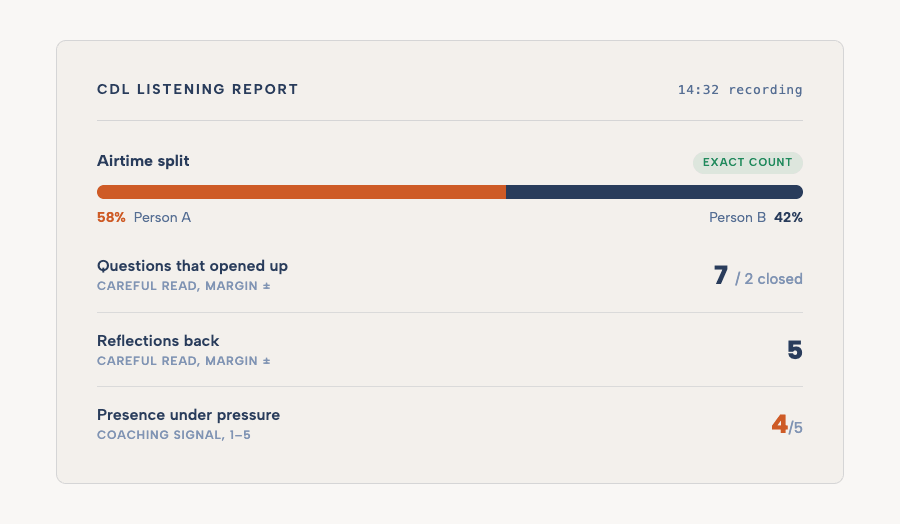
Most communication training ends when the room empties. Ours does not. Record one real two-person conversation and the app scores the listening: how the airtime split, how many questions opened things up versus closed them down, how often each person reflected back what they heard, and how steadily they stayed present when it got hard. The counting is automated. The meaning-making stays human, and it happens in the room, with you.
HONEST BY DESIGN
Every measure is labeled by how reliable it is. The airtime is an exact count. The question and reflection counts are careful reads with a margin. The 1 to 5 reads are coaching signals, not clinical scores. It is a read for growth, not a diagnosis.
“I’ve never seen anything like it. I’ve never participated in anything like that.”
— An early user of the lab’s app
WHAT TEAMS NOTICE
What teams notice
Less misunderstanding, more ownership, better meetings.
01.
Clear asks, clear next steps, fewer circular conversations.
02.
People speak up sooner, sound more credible, and stop freezing when the stakes rise.
03.
Better listening and better repair, so trust builds instead of quietly eroding.
04.
WHO IS THIS FOR?
People and L&D leaders, managers and team leads, client-facing teams, and high-potential talent who need to be heard.
Built for leadership development budgets.
Field-validated
Our pilot ran for over two years at the Paul College of Business and Economics at the University of New Hampshire. The lab has been delivered at companies like BAE Systems, Red Hat, Soho House, Blockchain Capital, Life Sciences Outsourcing, and Lonza.






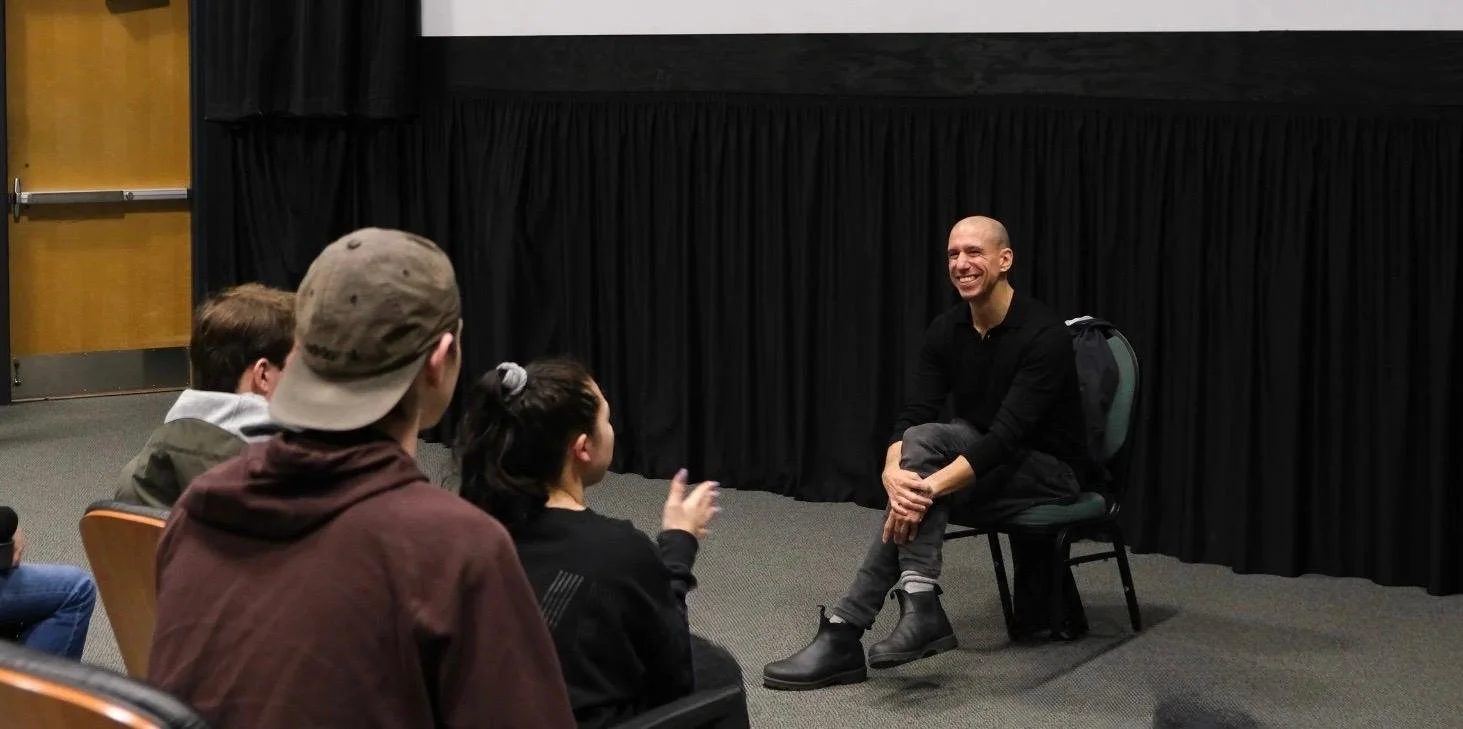
“Forget everything you know about forced team-building, corporate-bonding, hours-long seminars...this session will actually make you a better communicator and strengthen your relationship to your coworkers in a deep, meaningful way.”
— LSO Lab Participant
What participants say
-
"The role playing activities that we did truly made me open my eyes at the kind of listener I am. Being told that we don’t always have to respond to someone and just being there for them as they explained the situation was humbling as well."
-
"I would describe the Communication Dynamics Lab as a great opportunity to be put out of your comfort zone in order to become a better leader."
-
“I went into the training expecting for it to be a seminar styled, boring training, when it was more of an interactive learning environment that pulled you into wanting to be a part of the training, opening up freedom of topics around sensitive conversations with people.”
-
"I am a firm believer in fostering better communication and I strive to build community and comradery with my own teams, I've been through my share of bad corporate trainings. This session was unlike anything I've ever experienced. And I was so shocked at how much I had in common with my peers. Before this session I felt like I was off on my own island. But after, I have a team that I can effectively engage with in order to solve the most complex problems.”
-
"The practice conversations was super useful and something I plan to implement when I need to have another. The 'practice hard conversation' was useful, and the flipping of perspectives will help me find a better approach next time."
-
"The role-playing exercises I think really changed how I thought the training was going to go. It was eye-opening to heard from your partners point of view how you are communicating information and how they end up regurgitating it back to you in their own communication style."
FORMATS
Full-day workshop
Virtual lab
Pricing is scoped to your team on a short intro call.
The Communication Dynamics Lab warmup
SUPPLIER DIVERSITY
Veteran-owned. The Communication Dynamics Lab is an SBA Veteran-Owned Certified business, founded by a U.S. Navy Rescue Swimmer.
A clean fit for supplier-diversity and procurement requirements, especially with defense and manufacturing buyers.